Welcome to REAL-TEMP  A RT Product
A RT Product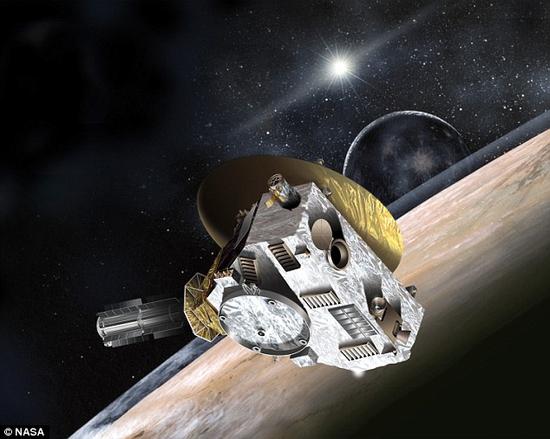
There remain many unsolved mysteries about Pluto. On July 15, 2015, as the New Horizons spacecraft (artist’s illustration) flies past Pluto, it is expected to bring us answers to some of these questions.

This artistic illustration depicts the view from one of Pluto’s smaller moons. The large dwarf planet located slightly right of the center is Pluto, while on the right side of the image stands Charon, Pluto’s largest moon.
Captured by New Horizons during its approach to Pluto, the footage shows Charon completing nearly one full orbit around Pluto. Charon circles Pluto at an orbital altitude of approximately 18,000 kilometers above the dwarf planet’s surface.
Sina Science and Technology News, Beijing Time, 21st — According to foreign media reports, after eight years of standby deep in space, roughly 4.8 billion kilometers from Earth, NASA’s New Horizons probe is about to wake up for a historic close encounter with Pluto. Scientists have prepared a six‑month mission plan. On December 6, the piano‑sized spacecraft will begin imaging Pluto and collecting scientific data.
Since its launch in January 2006, New Horizons has spent a total of 1,873 days in hibernation, accounting for two‑thirds of its total flight time. From mid‑2007 to late 2014, the probe entered 18 separate sleep cycles, each lasting between 36 and 202 days.
In hibernation mode, most onboard systems are powered down. The craft’s central computer monitors basic operations and transmits weekly status updates back to Earth.“New Horizons is healthy and cruising quietly through deep space, nearly 4.8 billion kilometers from home,” said Alice Bowman, Mission Operations Manager at the Johns Hopkins University Applied Physics Laboratory. “Its long rest is almost over. It is time for New Horizons to wake up, get to work, and make history.”
Mission operators activate the spacecraft roughly once per year to verify critical systems, calibrate scientific instruments, collect limited data, rehearse the Pluto flyby sequence, and perform trajectory adjustments when needed.
This past August, commands for the December wake‑up sequence were uploaded to New Horizons’ onboard computer. The probe is scheduled to resume full operations at 20:00 GMT on December 6 (04:00 Beijing Time on December 7). Roughly 90 minutes after waking, New Horizons will transmit a signal confirming its active status. Even traveling at the speed of light, this signal will take 4 hours and 25 minutes to reach Earth.
The New Horizons mission team in Maryland expects to receive the confirmation signal at 02:30 GMT on December 7 (10:30 Beijing Time). At that moment, the probe will be more than 4.6 billion kilometers from Earth and about 260 million kilometers from Pluto, a distance slightly less than twice the average separation between the Sun and Earth.
The core objectives of the mission are to study the geology and landforms of Pluto and Charon, map their surface compositions and surface temperatures, analyze the structure and chemistry of Pluto’s thin atmosphere, investigate Pluto’s smaller moons, and search for potential undiscovered satellites and ring systems.
New Horizons carries seven scientific instruments: advanced infrared imaging and ultraviolet spectrometers, a compact multi‑color imager, a high‑resolution telescopic camera, two powerful plasma spectrometers, a space dust detector, and dual radio science experiment units. The entire spacecraft is powered by a radioisotope thermoelectric generator, consuming roughly the same amount of electricity as two 100‑watt light bulbs.
Long‑range observations of Pluto and its moons will begin in January of the following year and continue through late July. The closest approach will occur on July 14. After years of preparation, the New Horizons team is fully confident in the upcoming flyby. Just one year after launch, the probe completed a flawless gravity assist and scientific encounter with Jupiter. Crews also conduct annual simulation drills to rehearse every phase of the Pluto arrival and flyby sequence.